
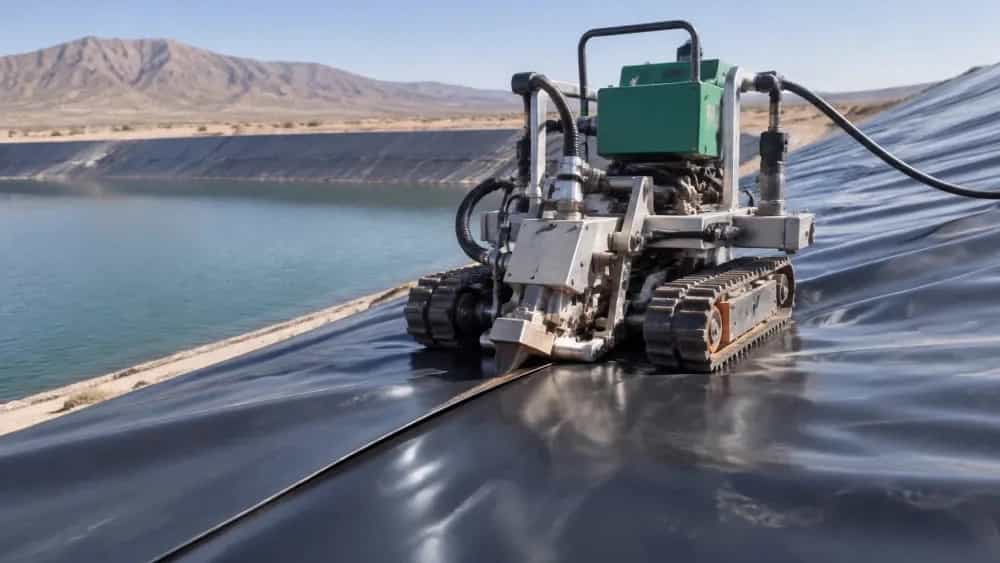
Supply and implementation of Farnam Bespar geomembrane sheets in Qom province requires knowledge of HDPE polymer composition, measurement of solar radiation rate and specialized implementation of automatic welding with hot wedge. Fidar Ferin Co., as a direct executor, implements the supply cycle of first-class petrochemical raw materials to air pressure welding test for water storage pool projects, industrial evaporation ponds and heavy foundations. Compliance with the tensile strength and the use of standard carbon black in these sheets prevents premature cracking caused by the difference in day and night temperatures in the central plateau of Iran.
1. Analysis of the behavior of Farnam Bespar polymer in atmospheric and soil conditions of Qom
Severe temperature changes in the industrial areas of Qom, such as Shekohiye Industrial Town, Mahmoudabad and Salafchagan, put polymer insulation coatings under constant thermal stress. In the central plains of Iran, the surface temperature of the dark sheet of the geomembrane reaches over 70 degrees Celsius at midday in summer and drops below zero in winter nights.
Field investigations by the technical team of Farin cover Fidar show that Farnam Bespar geomembrane sheets based on heavy polyethylene resin (HDPE) and at least 2-2.5% standard carbon black (Carbon Black) form a very powerful protective barrier against ultraviolet (UV) rays. The presence of pure carbon black with uniform distribution prevents the phenomenon of thermal oxidation and the brittleness of the molecular structure of the sheet in the long term.
On the other hand, the soil of Qom province, especially in the eastern areas and the edge of the desert, has a high concentration of chalk, sulfate and alkaline salts. Traditional sheets or reinforced concrete undergo chemical decomposition and rebar corrosion when exposed to these ions. The chain structure of Farnam Bespar polyethylene does not react with acids, bases and underground salt water, and the impermeability coefficient of liquids in it is almost zero.
2. Technical requirements of infrastructure and containment trench in rocky and clay bed
The mechanical stability of the polymer lining is completely dependent on the quality of the substrate surface preparation. In the alluvial plains of Qom, the presence of sharp-edged pebbles larger than 10 mm is considered a direct threat to sheet punching.
Excavation, compaction and geotextile bedding steps
- Regulation and tamping: The foundation soil should be tamped to at least 90% of the density of the proctor to prevent asymmetric settlement after dewatering.
- Protective layer (Geotextile): In coarse-grained soils, the implementation of non-woven polyester or polypropylene geotextile with a volume weight of at least 300 to 500 grams per square meter as a layer The protector dissipates point stresses.
- Anchor Trench: Digging a anchor trench at a distance of at least 50 cm from the upper edge of the pool to a standard depth and width of 50 x 50 cm is required. After the sheet is placed in this channel, it is filled and compacted with soil without rubble to control the tension caused by the weight of the fluid.
Our workshop experience in Shokohieh industrial town has proven that the common mistake of releasing the edges of the sheet without quickly stabilizing the trench in the monsoon winds of Qom will cause distortion of the rolls and tearing of the connections before the final welding.
3. Thermal welding techniques and quality control of joints
The critical point of durability of geomembrane projects is the quality of overlap lines. The standard overlap of Farnam Bespar rolls is considered to be between 10 and 15 cm, and welding is done only by modern calibrated devices.
Hot wedge automatic welding process
Complementary extrusion welding (Extrusion Welding)
In the corners, intersections and inlet and outlet pipes of the pool, where the rotation space of the hot wedge machine is not available, a manual extruder equipped with Farnam Bespar polymer wire is used. Before injecting the melt, the surface of the sheet is deoxidized by a sanding bur with appropriate roughness to create a homogeneous bond.
4. Inspection and Destructive and Non-Destructive Testing (NDT) Methods
It is not possible to confirm the health of connections without conducting ASTM standard tests. Frein implements the Fidar coverage of the quality control phase in three consecutive steps:
- Air Pressure Test: Both ends of the middle channel of the two-line weld are blocked and the air pressure needle connected to the manometer is inserted into it. The channel is inflated to a pressure of 2 bar (about 30 psi) and the system is isolated for 5 minutes. A pressure drop of less than 10% indicates complete sealing. Vacuum Box Test: For extrusion seams and spot welds, the weld surface is covered with soap foam and a transparent vacuum box is placed on it. By creating negative suction 5 times, the absence of bubbles is a sign of joint health.
- Peel and Shear laboratory tests: At the beginning of each work shift, welding test coupons are prepared and subjected to the tension of the tensile machine. The standard welding must be more resistant than the mother plate itself, so that tearing will definitely happen in the area of the plate (Film Tear Bond phenomenon).
5. Strategic applications in industries and agriculture of Qom province
- Large agricultural water storage ponds: 99% reduction of water loss in the pistachio orchards of Jafarabad, Nizar, and Salafchagan by inhibiting deep infiltration in sandy soils.
- Evaporation ponds and isolation of chemical effluents: In the electroplating, tanning and chemical zones of Qom industrial estates, preventing the leakage of toxic leachates into underground water tables with sheets The thickness of 2 mm is guaranteed.
- Sealing of building foundations and fire fighting tanks: Control of rising soil moisture in large construction complexes and containment of water settlement in heavy concrete structures.
Measurement engineering, direct loading from the factory, and elimination of sales intermediaries by Fidar coating furnace have made the finished costs of the projects to be controlled without sacrificing the quality of thickness and density of the sheet.
Technical and standard index | 1.5 mm thickness standard value | 2 mm thickness standard value | Test method Standard |
Polymer density | at least 0.940 grams per cubic centimeter | at least 0.940 grams per cubic centimeter | ASTM D1505 |
Tensile strength at yield point | Minimum 22 N/mm | Minimum 29 N/mm mm | ASTM D6693 |
Tensile strength at break point | Minimum 40 N/mm | Minimum 53 N/mm | ASTM D6693 |
Elongation at yield point | Minimum 12% | Minimum 12% | ASTM D6693 |
Elongation at break | Minimum 700% | At least 700% | ASTM D6693 |
Percentage of carbon black soot | 2.0 to 3.0 Percent | 2.0 to 3.0% | ASTM D1603 |
Tear resistance | At least 187 Newtons | Minimum 249 Newtons | ASTM D1004 |
Punch resistance | Minimum 480 N | Minimum 640 N | ASTM D4833 |